Mold remediation in Gettysburg, PA
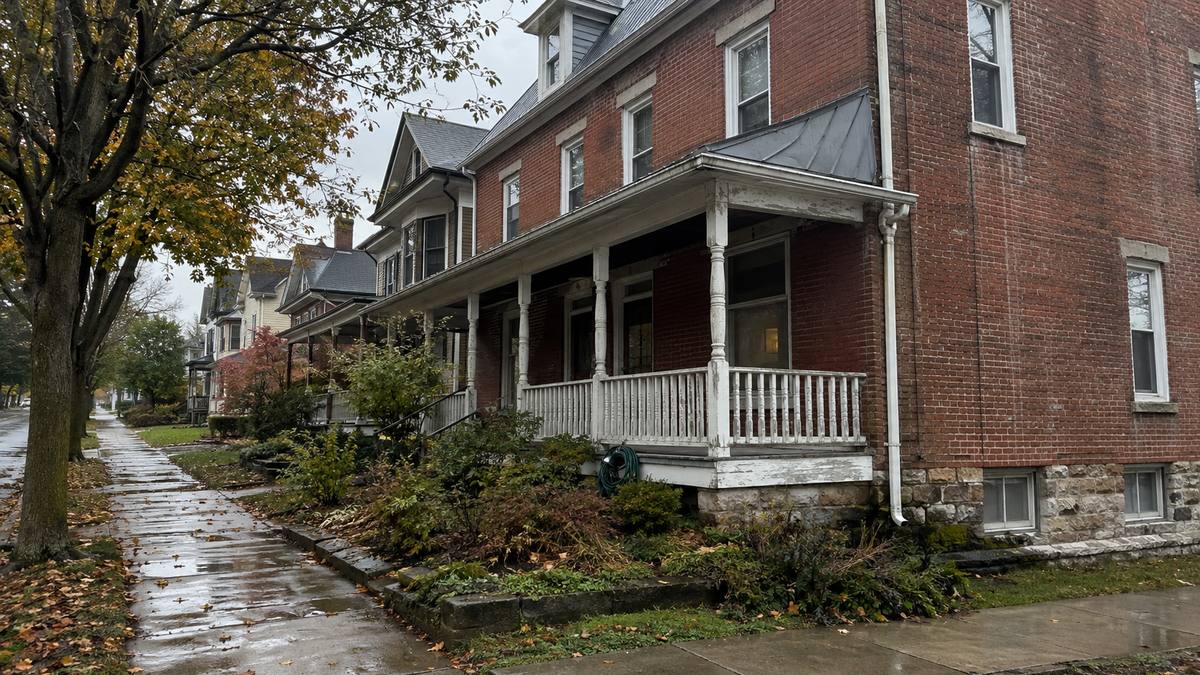
Half the homes in Gettysburg borough were built before 1940. Old stone and block foundations, cellars that were never meant to stay dry, and additions layered onto older walls are where mold problems start here. This page explains what remediation actually involves, what it costs, when you can handle it yourself, and how to check a company before you let one into your house.
What mold remediation actually involves
Remediation is not cleaning. A company that only wipes a surface has treated the symptom and left the cause. Every credible process follows the same order, and the first step is the one that matters most.
- Find the water. Mold grows because something is wet. A leak, a grading
problem, condensation on a cold surface, a bath fan venting into an attic. The EPA puts
this first:
The key to mold control is moisture control.
- Assess how far it goes. Growth on a surface often means more behind it. Moisture meters and probing find the wet edge of the material, which is usually larger than the stained area.
- Contain the work area. Sheeting over doorways and negative air pressure keep spores from moving through the house while materials are disturbed.
- Remove what cannot be cleaned. Porous materials that have grown mold, such as drywall, insulation and carpet padding, generally come out rather than getting treated in place.
- Dry the structure. The EPA's window is specific:
It is important to dry water-damaged areas and items within 24-48 hours to prevent mold growth.
- Fix the cause, then verify. If the moisture source is still there, the mold comes back, and you will have paid twice.
When you can do it yourself, and when you should not
Two different sources are commonly mashed together here, so it is worth separating them carefully, because they say different things.
The EPA addresses homeowners directly: If the moldy area is
less than about 10 square feet (less than roughly a 3 ft. by 3 ft. patch), in most cases, you
can handle the job yourself.
Above that size, the EPA does not say you must hire anyone.
It points you to a different EPA document written for building managers. The EPA also states
plainly that its guidance presents
recommendations
and that it does not regulate
mold or mold spores in indoor air
.
The Pennsylvania Department of Health goes further than the EPA does and recommends hiring a contractor for larger areas. If you have seen the 10 square feet figure presented as a legal cutoff, it is not one. It is guidance, and the two agencies use it differently.
It is also not a health threshold. The EPA's size tiers are drawn from the area affected rather than from health research, and the EPA says its guidance is not based on health effects. Ten square feet of growth is not safe and eleven dangerous. The figure is about how much work a person can reasonably handle without containment, nothing more.
The EPA does name two situations where it suggests bringing in help:
If you believe that you may have a hidden mold problem, consider hiring an experienced professional.
If you have health concerns, consult a health professional before starting cleanup.
Sources: EPA, A Brief Guide to Mold, Moisture and Your Home; EPA, Mold Cleanup in Your Home; PA Department of Health, Mold and Your Health. Retrieved September 15, 2026.
Do you need a mold test first?
Usually not, and both federal sources say so. The EPA: In most cases, if visible mold
growth is present, sampling is unnecessary.
The CDC is blunter: CDC does not recommend mold
testing
, because there are no
set standards for what is and what is not an acceptable quantity of different kinds of mold
in a home
.
That last point is the one to hold on to. There is no federal limit for mold in indoor air, so no test result can tell you that your house passed or failed. Testing is useful for specific questions: whether growth is present behind a wall you cannot open, or whether a completed job actually dried out. If a company recommends testing, ask what decision the result will change. If the answer is nothing, you are paying for paper.
One more caution worth knowing: you cannot identify a mold from a photograph, and colour does not establish species or hazard. Anyone who tells you otherwise from across a basement is guessing.
What it costs
These are market signals, not measured statistics. No government agency or independent statistical program publishes mold remediation pricing. Every figure below comes from cost guides, lead-generation marketplaces or contractor marketing pages, each of which has some interest in the number it publishes.
| Job | Commonly published range | Agreement between sources |
|---|---|---|
| Crawl space | $500 to $2,000 | Four sources agree exactly |
| Basement | $500 to $3,000 | Three agree; one guide starts at $1,500 |
| Attic | $1,000 to $4,000 | Three agree; one guide runs to $9,000 |
| Whole home | $10,000 to $30,000 | Four sources agree exactly |
| Per square foot | $10 to $25 | Four of five share the $10 floor |
| National average | $1,188 to $3,500 | Wide: the highest is nearly three times the lowest |
Two honest caveats. First, no Pennsylvania-specific figure could be verified at all, so treat any "PA average" you see, including on competitor sites, with suspicion. Second, when four separate pages publish an identical range to the dollar, that usually means one number propagating between them, not four independent observations.
A crawl space quoted at $500 to $2,000 for remediation and the same crawl space quoted at $5,000 to $15,000 are not the same job. The second almost always includes encapsulation, which is a moisture-control upgrade, not mold cleanup. Ask which you are being quoted.
Why Adams County houses have the problems they have
Housing age is the single most useful predictor of where mold turns up, and it varies sharply within a few miles here.
| Town | Median year built | Built before 1940 |
|---|---|---|
| Gettysburg | 1942 | 47.5% |
| Cumberland Township | 1983 | 5.2% |
| Straban Township | 1979 | 12.5% |
| Mount Joy Township | 1980 | 12.3% |
| Fairfield | 1947 | 40.4% |
| Carroll Valley | 1993 | 2.2% |
Gettysburg borough sits at a 1942 median with 47.5 percent of homes predating 1940. Nine miles southwest, Carroll Valley sits at 1993 with 2.2 percent. Those are different problems. Old masonry basements wick ground moisture and were never built with perimeter drainage. Newer sealed houses trap humidity, and their failures tend to be mechanical: a bath fan ducted into an attic, a crawl space vapor barrier that has torn open.
Housing figures: U.S. Census Bureau, American Community Survey 2024 5-year estimates, tables B25035 and B25034, retrieved September 15, 2026.
County-level context, which applies to the area rather than to any one town: Adams County averages 43.11 inches of precipitation a year, plus about 22 inches of snow, most of it between December and February. There were 26 flash flood events in Adams County between 1996 and 2019. Two watersheds split the county almost evenly: about half drains northeast to the Susquehanna by way of Conewago Creek, and about half drains south and west toward the Potomac by way of the Monocacy.
Source: Adams County Hazard Mitigation Plan (2020 update), retrieved 2026-09-15. Adams County Stormwater Management Plan, retrieved 2026-09-15.
Where it shows up
Basement mold removal
Block and stone foundations, damp corners, efflorescence and the water that causes it.
Crawl space mold remediation
Vented crawl spaces, ground moisture, vapor barriers and sagging insulation.
Attic mold removal
Sheathing staining, bath fans venting into the attic, and blocked soffit vents.
How to check a company before you hire one
Pennsylvania does not license this trade. The Department of Health says so directly: There
are no federal or Pennsylvania state regulations about mold.
The same factsheet adds that Pennsylvania
has no state law about landlord duties for mold prevention or repair.
So there is no state credential to ask for. That puts the burden on you, and these five questions do most of the work:
- Is the company IICRC certified, and can I verify it? IICRC is an industry body, not a government one, and a firm's status can be checked directly at iicrc.org. A technician holding a certificate is not the same as a Certified Firm.
- Are you registered as a Pennsylvania home improvement contractor? Most residential work of this kind falls under that registration, which is administered by the Attorney General's office rather than a trade board.
- What is the moisture source, and what is your plan for it? If a quote covers cleanup with no repair, the mold has a return ticket.
- What is the written scope? Containment, what gets removed, drying targets, and how completion is verified.
- Do you do the testing and the remediation? A company that sells both has an interest in the result. Independent testing avoids that.
The EPA's version of the same advice is short: make sure the contractor has
experience cleaning up mold.
About bleach
The two agencies differ here, so do not blend them. The EPA does not recommend it as routine: The use of a chemical
or biocide that kills organisms such as mold (chlorine bleach, for example) is not
recommended as a routine practice during mold cleanup.
The CDC gives a dilution for hard
surfaces, no more than 1 cup of
household laundry bleach in 1 gallon of water
, and one absolute rule: Never mix bleach with ammonia or
other cleaners. This will produce a poisonous gas.
On protective equipment, keep the sources separate too. The EPA is the one that specifies an N-95 respirator at minimum, long gloves that extend to the middle of the forearm, and goggles without ventilation holes. The CDC lists an N-95 respirator, goggles and protective gloves for disaster cleanup, without the unvented detail. The unvented-goggles specificity is EPA's, so do not credit it to all of them.
What this site is. Gettysburg Mold Remediation is an independent referral service operated by Front Door Digital LLC. We do not inspect, test or remediate mold ourselves, and we are not a contractor. We connect homeowners with independent local companies that do this work.
Where we cover
Adams County and the Hanover area of western York County, Pennsylvania. Each town page carries its own housing and moisture data rather than the same paragraph with a name swapped.
Gettysburg, Cumberland Township, Straban Township, Mount Joy Township, Fairfield, Carroll Valley, Biglerville, Arendtsville, Bendersville, York Springs. All service areas.
Getting help right now
You can call this site at (717) 707-7286. The call is not recorded, there is no automated assistant on the line, and nothing about you is passed to a remediation company unless you ask to be connected. What the call is good for, and the things we cannot do, are set out on the how calls work page.
If you would rather work through it yourself first, use the five questions above with two or three local companies, and read the Pennsylvania Department of Health's factsheet, which is free and short. If your problem is smaller than roughly a three-foot square and you know where the water came from, the EPA's homeowner guide walks through doing it yourself safely.